
The platform industrial autonomy runs on.
Not an application. Not a point solution. The infrastructure layer that deploys, governs, and scales autonomous control across every asset — continuously, without rebuilding from scratch each time.

IN PRODUCTION
Deployed across North America
50%
Faster OT implementation
3793
Assets miles
Industrial
autonomy, defined
Industrial autonomy is the category of software systems that autonomously execute, deploy, and optimize industrial control applications — combining physics-first control execution with agentic platform deployment, under continuous human governance.
It is the missing layer between operational data and physical action — where monitoring and recommendations become autonomous execution, at scale.
Executes
Physics-first autonomous control that acts within the real constraints of industrial systems.
Deploys
Agentic configuration, validation and rollout across multiple assets without rebuilding from scratch.
Governs
Continuous operator authority, traceability and defined operating envelopes at every layer.
Most industrial software ships logic. CruxOCM ships a logic factory.

Why Now
Three forces
are converging
2M+
miles of pipeline assets in North American midstream — with the same physics problem extending across chemicals, pharma and water utilities.

Capital constraint
Operators must maximize returns from existing infrastructure. Autonomous control protects margins without requiring major new capital spend.

Workforce pressure
Experienced engineers are retiring. IAH encodes best-practice control logic and preserves it reliably across every asset.

Platform maturity
The infrastructure required for self-configuring, self-tuning deployment now exists at production grade. The technology caught up to the problem.
How the Platform Works
Every layer
monitors. Every
layer recommends.
Only one executes.
The industrial automation stack was built layer by layer. What remained unbuilt was execution at scale.
Visibility
SCADA / DCS
Recommendation
Optimization + data platforms
Execution
IAH™ platform

IAH does not replace control applications. It scales them.
Each deployment makes the next one faster and cheaper.
A configuration validated on one asset becomes the template for the next. Drag through the asset base — watch the platform compound.
Deployment stage
First deployment
Custom configuration is created and validated.
Time to deploy
Months
Each deployment requires less repeated work.
Configuration mix
Custom
The first reusable platform template is established.
01 First deployment
Currently viewing: first deployment
+ Platform compounds
Drag to see how each deployment compounds the platform’s economics
01. First deployment
Custom logic becomes
a reusable template.
The first configuration is engineered for the asset, validated in production and added to the platform library for future deployments.
Reusable logic library
3 newly validated modules

Hydraulics

Pressureenvelope

Flow logic

Governance

SCADAbridge

Assetvariables
- Newly validated
- Reused from the library
- Not yet available

Platform Economics
The shift that
makes the category economically viable.
Without IAH, every asset requires its own deployment cycle. With IAH, validated logic is reused, parallel rollout becomes possible and the cost per asset declines.
Request investor briefDeployment cost per asset
Conceptual economics as assets scale.



Without IAH, deployment cost per asset stays flat or rises from asset 1 to asset N. With IAH, it compounds down.
Deployment time: about 180 days without IAH, about 20 days with IAH — months become weeks.
Rollout pattern: serial without IAH, parallel with IAH.


Value over time: degrades at baseline, compounds with IAH.
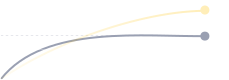
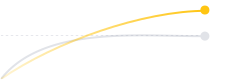
Scale capacity: team-bound at baseline, expands with IAH.
Safety & Control
Physics first.
Operator controlled.
Every decision stays inside the system's real constraints. The operator can approve, override, set limits or halt the system at any point.

01
Data In
Production

02
Physics Applied
constraints

03
Decision Made
Logic

04
Action Executed
Production

05
Operator Notified
governance

Agentic deployment for industrial autonomy
Ownership of a category, not participation in one. Each of these companies owns a defining layer of enterprise infrastructure.
Palantir
Owns the ontology
The semantic layer that connects operational data to decisions across the enterprise.
Databricks
Owns the lakehouse
The unified data and analytics platform that consolidates enterprise information at scale.
CruxOCM
Owns agentic deployment for industrial autonomy
The only platform that autonomously configures, validates, deploys and continuously optimizes control applications across industrial assets — without manual engineering at each step.

Governance isn't a safety net. It's the competitive barrier.
Operators will not adopt autonomous control from a vendor they cannot audit, override or hold accountable. IAH makes governance part of the architecture.
What everyone else offers
Governance as compliance
- Human oversight added after the fact
- Approval workflows bolted onto recommendations
- No traceable deployment history
- No operator-defined operating envelopes
What IAH is built on
Governance as architecture
- Operator authority at every layer
- Every configuration and change traceable
- Physics-first logic inside defined envelopes
- Approve, override, set limits or halt
Control logic built on validated first-principles models. Not statistical inference. Not language models. Pipeline physics.







This technology will disrupt the energy sector, enhancing efficiency and safety.
Products prove the value. The platform
scales it. The category follows.
This is not just a product roadmap. It is how CruxOCM becomes the platform industrial autonomy runs on — across every industry that moves liquid through pipe.
Today · Products
01
pipeBOT™ + gatherBOT™
Deliver measurable operational gains from day one. This is how customers experience value today.
Platform · IAH™
02
Repeatable
deploymentEach new asset is faster and cheaper than the last. The platform learns from every deployment.
Horizon · Category
03
Every industry
that moves liquidMidstream is the proving ground. Chemicals, pharma and water utilities are next.
FAQS
What operators ask us
before they deploy
Pick a topic, then open the question you care about.
CruxOCM follows a modular, layered architecture designed to sit on top of existing pipeline infrastructure. The Platform Layer — the Industrial Automation Hub (IAH™) — provides the stable foundation. The Automation Layer runs real-time control applications such as pipeBOT™ for pipeline automation and gatherBOT™ for gathering system optimization. The Optimization Layer adds solutions like maxOPT™, leanOPT™, and powerOPT™ to fine-tune performance against specific business objectives.
This structure enables scalable deployment and continuous performance improvement across the midstream energy value chain.
Building the category.The window is open now.
The operators who deploy autonomous control at scale now will accumulate compounding optimization intelligence their competitors cannot replicate