The Evolution in Pipeline Operations: From SCADA to Closed-Loop Pipeline Automation
Published:
When pipelines became a critical piece of infrastructure in the 1950s, they were rudimentary. In the early days, if you wanted to change a valve or check a pressure reading, someone had to drive out to the middle of nowhere in a pickup truck and physically turn a wheel. It wasn't until the first examples of the later hyped IoT became accessible that the in-field, manual operations could be replaced by a Supervisory Control and Data Acquisition System (SCADA) or Distributed Control System (DCS). This advancement allowed for larger pipelines, better safety monitoring, quicker reactivity, and a centralized location for data flow. New access to data allows companies to see problems and opportunities on the pipeline, facilitating the introduction of new technologies to improve operations.
As technology continues to evolve at hyper speed, the results of those technological improvements slowly seep their way into industrial applications. Pipeline operations have become a complex interplay of technologies. In-house operations teams have built enhancements on their systems, and external companies have created and utilized Advanced Process Control (APC) and other closed-loop systems that solve more complex operational challenges.
More recently, we have seen an increased focus on optimization. Due to the political and economic challenges associated with building new infrastructure, companies are shifting focus to getting the most barrels out of the existing pipelines. This focus on optimization has led to the development of recommender systems, and the potential to utilize everyone's favourite buzzword — AI.
Pipeline operations have become a complex interplay of technologies. We will be comparing and contrasting the various technologies. However, to simplify their interconnectivity, we will consider a more relatable example — a car. In this example, the mechanical parts align nicely. The brakes mimic control valves (or VFDs), the frame mimics the pipe, and the steering wheel and brake pedals — the HMI.
The Electronic Control Unit: SCADA and DCS Systems
Without SCADA, our pipeline would mimic Fred Flintstone's car — needing to be manually pushed and prodded to keep moving. SCADA is the foundation that brings the operations from the field into the control room, and allows for operators to continuously monitor and control the system. While these systems on their own do not optimize, and do not automate, they provide the framework for everything else to come.
SCADA systems provide some essential benefits.
- Provide a centralised system of integration.
- Can be built on and expanded.
- Allow for some enhancements.
- Ensure system monitoring, control and execution of commands.
However, having SCADA alone remains a limited solution for several reasons.
- Requires a large configuration effort.
- Enhancement capacities are limited.
- Leaves the majority of control execution to the operator.
Soup Up the Car: In-House Automation
With SCADA, our Flintstone car has advanced into Ford's Model T, manufacturing at scale in the 1920s. As famously stated by Henry Ford, "Any color the customer wants, as long as it's black." This base SCADA system gets us running a control centre. From here, operations teams come in, find new ways to improve the control room experience, and work on enhancements that lead to better operational outcomes. Some of these changes become standard in the industry, like the introduction of local PLCs (Programmable Logic Controllers). Others are like a new paint job, or the spoiler — not critical, but makes the ride nicer.
In-house automation can provide some operational benefits.
- Can improve the overall monitoring or control of a pipeline.
- Can provide some optimization support.
- Can partially automate the operations.
Yet, it is an essentially limited approach due to its core characteristics.
- Not scalable — typically done on one system at a time.
- Not system-wide — typically limited to parts of a system that act independently of one another.
- Often still require significant input from an operator.
Cruise Control: Advanced Process Control (APC)
Now we add standard cruise control to our car. You lock in a speed, and the car maintains it by managing the throttle over hills and valleys. These systems are exceptional at managing specific constrained process variables within a tight boundary — like stabilizing a pump station's discharge pressure to manage a target flow. It keeps your foot off the gas pedal for a bit, but the moment you hit a highway (need to start pumps) or a winding road (need to swing the line to a different flowpath), the cruise control disengages and hands full control right back to you.
APC offers significant operational benefits.
- Excellent at stabilizing specific process variables within local boundaries while advancing to a system-wide operating condition.
- Reduces operator cognitive load during steady-state and some transient operations.
- Delivers proven, math-based continuous optimization.
Like previous advancements, it has several important limitations.
- Does not manage discrete controls (e.g. pump statuses).
- Requires complex models to be able to coordinate across the entire pipeline asset footprint.
- Without telemetry or hydraulic model integration, critical midline locations may lack operational visibility and control.
The Navigation System: AI Recommenders
This is your modern infotainment system. You're driving down the highway, you ask your AI assistant to find a faster route, and it gives you a brilliant suggestion — hopefully. It could also be the navigation system telling you to turn around repeatedly because it doesn't know you decided to stop for a coffee.
In the industry, data platforms like Cognite, Imubit, or Phaidra crunch massive datasets to provide predictive maintenance insights or setpoint recommendations. While some niche AI applications claim limited closed-loop pipeline control in very narrow asset contexts, for broader pipeline operations they function primarily as a "recommender system." They advise the operator, and it is still entirely up to the human to execute it through SCADA. The insights AI recommenders offer can become noise, adding cognitive load for the operator rather than executing tasks as closed-loop systems can.
Here are some benefits that AI recommenders deliver.
- Unmatched at finding hidden patterns, anomalies, and predictive maintenance risks.
- Provides highly advanced analytics across massive historical data lakes.
- Flexible and adaptable to varying types of operational data.
Main limitations operators encounter when using AI recommenders include the following.
- Mostly advisory, and still relies heavily on the operator to read, trust, and manually execute recommendations.
- Depends on context, since AI execution capabilities are isolated and rarely cover system-wide coordination.
- Can suffer from a "black box" problem, where operators don't understand why a recommendation was made, leading to low adoption.
Adaptive Cruise Control or Self-Driving: Closed-Loop Pipeline Automation
This takes us to adaptive cruise control or highway autopilot. The car doesn't just maintain a static speed; it reads the traffic ahead, slows down as the car in front brakes, accelerates when the lane clears, and stays perfectly centered in the lane without you touching the pedals. In our market, this is closed-loop pipeline automation, engineered by companies like CruxOCM. Operating directly on top of your existing SCADA infrastructure, it acts as a continuous execution layer. Instead of waiting for an operator to click through fifty manual steps to execute a start-up or a flow rate change, a closed-loop system safely and dynamically drives the pipeline across multiple stations simultaneously to hit maximum throughput.
Closed-loop pipeline automation delivers significant benefits.
- Executes complex, multi-system operations continuously without manual operator clicks.
- Safely pushes operations right up to true hydraulic constraints in real time.
- Operates during both steady-state and transient conditions.
However, it does have some limitations.
- Depends entirely on the quality of the underlying SCADA data layer.
- Focuses on execution and throughput maximization rather than deep asset health analytics.
Evaluating the Pipeline Automation Approaches
To map out how these technologies sit together in a modern control room, we can look at how they address specific operational capabilities. The columns below are SCADA / DCS (ABB, Emerson), APC (AspenTech, AVEVA), AI / data platforms (Cognite, Imubit), in-house automation, and closed-loop pipeline automation (CruxOCM).
| Capability | SCADA / DCS | APC | AI platforms | In-house | Closed-loop |
|---|---|---|---|---|---|
| Monitoring — real-time visibility into pressures, flows, and statuses across the asset | ✔ | ✔ | ✔ | ✔ | ✔ |
| Control execution — toggle valves, start pumps, and adjust setpoints | ✔ | ✔ | Varies* | ✔ | ✔ |
| Optimization — the most efficient or highest-throughput operating strategy | ✖ | Partial | ✔ | Partial | ✔ |
| Continuous execution — multi-step sequences adjusted in real time as conditions change | ✖ | Limited | Limited* | Limited | ✔ |
| System-wide coordination — simultaneous control across stations to balance hydraulics | ✖ | ✖ | ✖ | ✖ | ✔ |
| Human dependency — manual intervention required from the control room operator | High | Medium | High | High | Low |
| Scalability — ease of deploying across multiple lines and diverse asset classes | Medium | Low | Medium | Low | High |
*Note on AI: While many AI tools are strictly diagnostic, select vendors like Imubit and Phaidra do perform closed-loop control for pipeline operations, though typically constrained to localized process equipment rather than system-wide pipeline hydraulics.
Where Each Approach Breaks Down in the Field
To truly understand these approaches, we have to look past the marketing brochures and see how they behave when real operational friction occurs.
SCADA Vendors: The Operator Bottleneck
SCADA is brilliant at execution and safety monitoring, but it is inherently passive. It does nothing until a human tells it to.
The real-world scenario: A pipeline experiences a sudden pressure upset (pump trip). The SCADA system may alarm and show the falling pressures. However, to re-optimize the line, the operator must determine new setpoints, click through various different station screens, and adjust multiple pumps one by one. If they are not quick enough, the system may reach a state where a shutdown is required, losing valuable throughput.
APC Vendors: The Boundary Wall
APC handles dynamics well, but it breaks down when system dynamics require discrete operational changes.
The real-world scenario: During a flowrate change, the hydraulics demand that an additional pump be started at a station. Because the APC's mathematical models are built for continuous controls, the system cannot start the pump, and instead will get stuck at the current flowrate. Manual intervention is then required to start the pump.
AI Platforms: The "Advisory Only" Gap
AI recommendation platforms can find incredible efficiencies in your data, but they lack a seamless way to turn those insights into physical motion.
The real-world scenario: An AI tool analyzes hydraulic trends and recommends an optimized pressure profile to increase efficiency. It issues a notification to the operator. The operator, busy managing multiple screens, alarms, and maybe a phone call, either misses the prompt or decides not to trust the "black box" calculation, and the recommendation sits unexecuted. Even if they do go to implement it, they are responsible for determining how to transition to that state, and are often delayed in doing so.
In-House Teams: The Custom Code Trap
Custom internal scripts are great for hyper-specific niche problems, but they are incredibly fragile over the long term.
The real-world scenario: A brilliant senior automation engineer automates a specific pump-switching sequence. It works flawlessly for two years. The operations team is so happy with it that they request similar logic across other pipelines. However, the automation was built with specific requirements in mind, and can't be easily extended to other pipelines. The engineer now needs to rebuild and modify the logic for each new application.
Designing the Modern Stack for Closed-Loop Pipeline Automation
This is not a story about ripping and replacing your existing software stack. No single technology listed above is a silver bullet that can run a pipeline alone. Instead, maximum efficiency is achieved by strategically layering these technologies so that they complement one another.
- SCADA/DCS remains the untouchable foundation. It talks to the steel in the ground, enforces safety overrides, and provides the core data streams.
- APC continues to do what it does best: holding specific, localized process variables perfectly steady.
- AI platforms sit to the side, acting as the brain that ingests historical data to deliver macro insights and predictive health alerts.
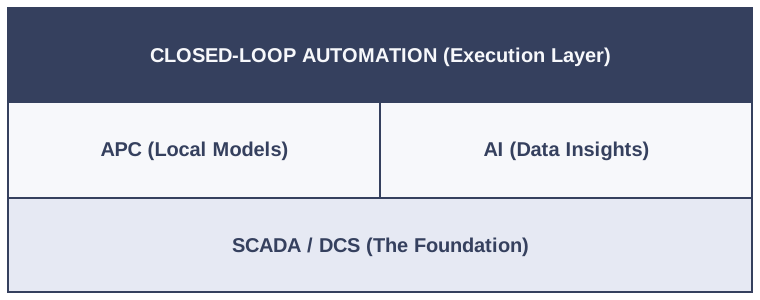
- Closed-loop pipeline automation wraps around the stack as an execution layer. It takes the safety parameters from SCADA, the steady-state logic of APC, and the high-level goals of the business, and continuously turns them into synchronized, system-wide physical actions.
- Optimization applications enhance the automated execution by setting targets to achieve optimal asset exploitation. Such control applications calculate, identify, and recommend operational targets. Integrated with a closed-loop control platform, they help consistently meet nominations, extend the lifecycle of the asset, and help reduce OPEX.
The layers sit like this, from the execution layer down to the foundation. APC and AI sit side by side on top of SCADA.
Best Time to Deploy Each Approach
Because no single approach can run a pipeline alone, knowing when to deploy each technology is key to building an effective, layered automation stack.
- SCADA: Always required from day one.
- APC: Best for highly specific, localized process optimization challenges with fixed parameters.
- AI: Best when you have massive amounts of unutilized data and need deep insights, anomaly detection, or asset health forecasting.
- In-house: Best for minor, localized HMI preferences or highly custom, non-standard field equipment tweaks.
- Closed-loop pipeline automation: Best for complex, multi-system pipeline networks where maximizing daily throughput depends on continuous, fast, and unified execution across the entire asset. When operations need to be fine-tuned for maximum efficiency and profitability, optimization applications can supplement the automation layer.
The Missing Piece
The pipeline industry has spent decades mastering control systems, building optimization models, and deploying advanced AI analytics. But until recently, we have lacked a dedicated layer to execute those optimization decisions continuously across an entire system without relying on an operator making hundreds of manual clicks and being overwhelmed with information. By implementing a closed-loop pipeline automation layer on top of a rock-solid SCADA foundation, operators can finally turn their optimization theory into continuous, safe pipeline reality. That execution layer is industrial autonomy.
Share this article


Collaborators

Written by
Monika Wasylkiewicz
Senior Product Manager at CruxOCM
Product leader focused on pipeline hydraulics, autonomous control, and optimization for midstream operations.