Advanced Process Control (APC): Definition, Techniques, Benefits, and Applications
Published:

Advanced process control (APC) is a set of control techniques and software that runs above basic PID loops and coordinates many process variables at once. Its job is to hold a plant or pipeline as close as possible to its most profitable operating point without crossing equipment, quality, or safety limits.
A basic process control system holds each variable at the setpoint someone chose for it. It does not decide whether that setpoint is the right one, and it does not coordinate loops that affect each other. Operators compensate by running with a margin from the limits. That margin is lost throughput, wasted energy, and less consistent product.
Advanced process control reduces that margin. An APC controller predicts how the process will respond, calculates new setpoints for the basic control layer every few seconds to minutes, and moves the process toward its constraints in a coordinated way.
This article explains how APC works within the control hierarchy, how it differs from basic process control, the main APC techniques, the components of an advanced process control system, where APC is used, its benefits and challenges, how to implement APC software, and what APC means in pipeline operations.
What Is Advanced Process Control (APC)?
Advanced process control is any control strategy added on top of the basic regulatory control layer to improve how a process performs. In a 2025 plantwide control course, Professor Sigurd Skogestad of the Norwegian University of Science and Technology (NTNU) describes "advanced" as a relative term: it usually covers anything that sits above basic PID loops, and it is mainly used in the supervisory control layer.
APC has three defining capabilities:
- Prediction. An APC controller uses a model of the process to estimate how measured variables will respond to a change before the change is made.
- Multivariable coordination. APC moves several manipulated variables together and accounts for how they interact, instead of tuning one loop at a time.
- Constraint handling. APC knows the process limits, such as maximum pressure, valve position, or product specification, and operates close to them without violating them.
The regulatory layer keeps the process stable. APC uses that stable base to pursue an economic objective, such as more throughput, lower energy use, or tighter product quality.
One boundary is worth stating. In the pipeline industry, "APC" can also mean advanced pipeline control, which refers to automating pipeline operations that are still run manually. The section on APC in pipeline operations below explains the difference.
How Advanced Process Control Works in the Control Hierarchy
Advanced process control works by sitting in the supervisory layer of the process control hierarchy, between real-time optimization above and regulatory control below. Each layer runs on a different time scale. Skogestad's chapter on plantwide control in Ullmann's Encyclopedia of Industrial Chemistry describes the typical split: regulatory control acts in seconds, supervisory (predictive, advanced) control in minutes, local optimization in hours, site-wide optimization over a day, and scheduling over weeks.
| Layer | Typical time scale | What it does | Typical technology |
|---|---|---|---|
| Planning and scheduling | Days to weeks | Decides what to produce or move, and when | Planning and scheduling software |
| Real-time optimization (RTO) | Hours | Calculates the economically best targets for current conditions | Steady-state process model with an optimizer |
| Advanced process control | Minutes | Moves the process to those targets while respecting constraints and interactions | Model predictive control, advanced regulatory control |
| Regulatory control | Seconds | Holds each variable at its setpoint and rejects local disturbances | PID loops in the DCS or PLC |
| Field devices | Continuous | Measure the process and act on it | Transmitters, valves, pumps, motors |
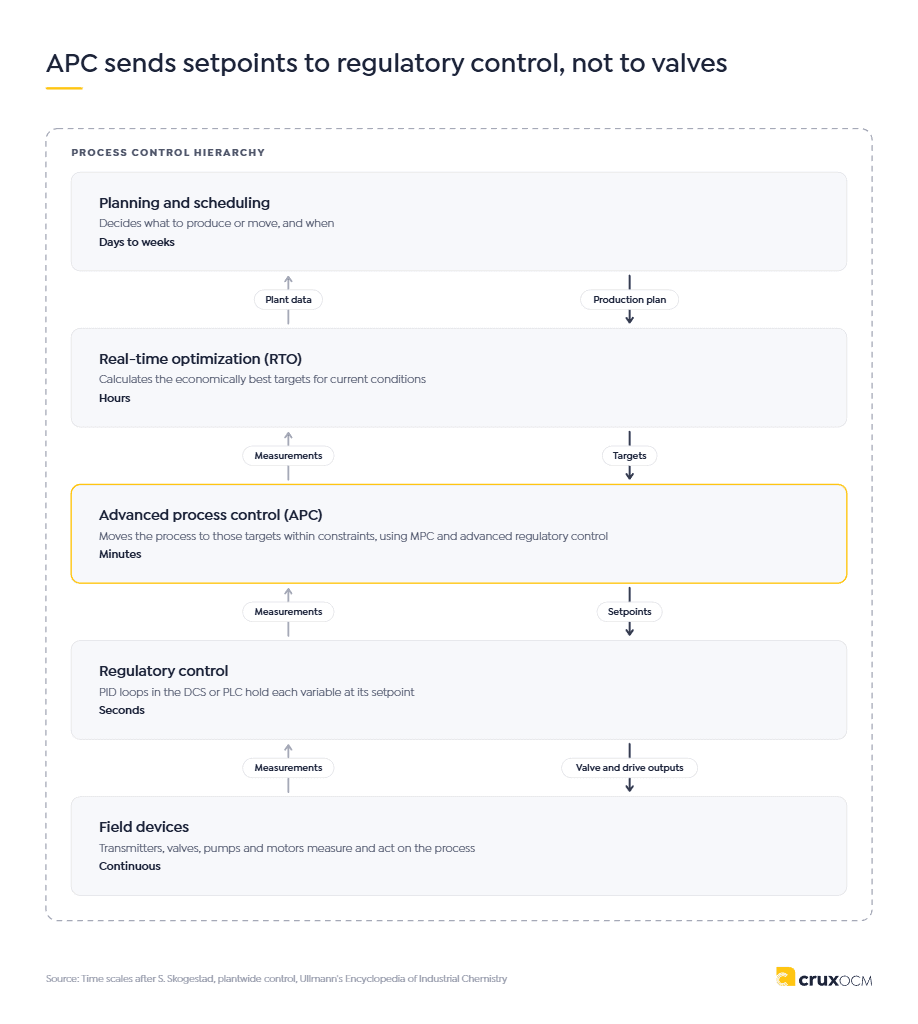
In a typical installation, the APC application reads live measurements from the distributed control system (DCS) or SCADA system, runs its calculation, and writes new setpoints back to the PID controllers. The PID loops then move the valves and drives. Control Engineering describes the same sequence for an APC project: the team defines the communication protocol between the APC workstation and the DCS before the controller goes live.
Safety instrumented systems sit outside this hierarchy. APC operates inside the limits those systems enforce and does not replace them.
Basic Process Control vs. Advanced Process Control
The difference between basic process control and advanced process control is scope: a basic process control system (BPCS) holds one variable per loop at a fixed setpoint, while APC coordinates many interacting variables toward an economic target.
| Characteristic | Basic process control (BPCS) | Advanced process control (APC) |
|---|---|---|
| Scope | One controlled variable per loop | Many interacting variables in one controller |
| Timing | Reacts after an error appears | Predicts the response and acts ahead of it |
| Constraints | Alarms and interlocks at the limits | Handles limits explicitly and runs close to them |
| Objective | Track the setpoint | Reach an economic target within constraints |
| Where it runs | Controllers in the DCS or PLC | DCS application or supervisory computer |
| Who sets the target | The operator | Real-time optimization, the operator, or an economic objective in the controller |
APC does not replace the basic layer. It depends on it. A controller that writes setpoints to poorly tuned PID loops or faulty instruments cannot perform, which is why most APC projects start by checking the regulatory layer.
Advanced Process Control Techniques
Advanced process control techniques range from simple additions to PID loops to multivariable controllers built on a dynamic model. Most APC applications combine several of them.
Advanced regulatory control (ARC)
Advanced regulatory control adds standard elements to single PID loops: feedforward, cascade, ratio, override (selector), and adaptive gain. Skogestad notes that ARC has been in industrial use since the 1930s and is still widely used, and that its main limitation is that it is built from single loops, so the engineer has to choose which variable each loop controls.
Model predictive control (MPC)
Model predictive control uses an explicit dynamic model of the process to predict its future response and calculates the best sequence of moves for several manipulated variables at once, subject to constraints. In their 2003 survey of industrial MPC technology, published in Control Engineering Practice, S. Joe Qin and Thomas A. Badgwell note that MPC was first developed for the control needs of power plants and petroleum refineries and later spread to chemicals, food processing, automotive, and aerospace applications. MPC is the technique most people mean when they say "APC."
Multivariable control
Multivariable control manages processes where one input affects several outputs. Changing a reboiler duty on a distillation column, for example, changes both product compositions and the column pressure. A multivariable controller accounts for these interactions, which single-loop control cannot do. MPC is the most common form of multivariable control in industry.
Inferential control and soft sensors
Inferential control estimates a variable that is measured slowly or not at all, such as product composition, from variables that are measured quickly, such as temperatures and pressures. The estimate, often called a soft sensor, gives the controller a value to act on between laboratory samples or analyzer updates.
Real-time optimization (RTO)
Real-time optimization uses a steady-state model of the process to calculate the most profitable targets for current prices, feed, and conditions, and passes those targets down to the APC layer. Skogestad notes that RTO is used in a limited number of applications, mostly in refining.
Machine learning in advanced process control
Machine learning models are increasingly used as soft sensors or as process models inside APC. They have a practical limit: Skogestad points out that data-driven models need large amounts of operating data and can only be built after a process has been running.
| Technique | What it does | Typical use |
|---|---|---|
| Advanced regulatory control | Adds feedforward, cascade, ratio, and override logic to PID loops | Disturbance rejection on individual loops |
| Model predictive control | Predicts the response and calculates coordinated moves within constraints | Distillation, reactors, compressors, furnaces |
| Multivariable control | Handles interactions between several inputs and outputs | Units with tightly coupled variables |
| Inferential control | Estimates unmeasured qualities from fast measurements | Product composition, quality targets |
| Real-time optimization | Calculates the economically best targets | Refinery-wide or unit-wide economics |
Components of an Advanced Process Control System
An advanced process control system is built from six components that work together.
- Process model. A dynamic model that describes how each controlled variable responds to each manipulated variable. Control Engineering describes the usual method: engineers run plant tests, step the inputs, and identify the model from the recorded response.
- Real-time database and historian. Stores live and historical measurements for the controller, for model building, and for performance reporting.
- Controller engine. Solves the control and optimization problem every cycle and calculates new setpoints.
- Interface to the DCS or SCADA system. Reads measurements and writes setpoints through a standard protocol such as OPC, or through a native DCS link.
- Operator interface. Lets operators switch the controller on and off, set limits for each variable, and see what the controller plans to do next.
- Performance monitoring. Tracks how often the controller is on, how close it runs to its constraints, and the value it delivers, so engineers can see when the model needs updating.
Advanced Process Control Applications by Industry
Advanced process control is used wherever a continuous process has interacting variables, measurable economics, and limits worth running close to.
- Refining. Crude distillation, fluid catalytic cracking, hydrocracking, and delayed coking units use APC to increase yields of high-value products while holding product specifications.
- Chemicals and petrochemicals. APC controls reactors, distillation trains, and furnaces, where small gains in yield or energy use are worth a lot at scale.
- Upstream oil and gas. Upstream operations cover exploration and production: drilling wells and separating the produced oil, gas, and water at the wellsite or a central processing facility. APC stabilizes separator levels, stabilizer columns, and gas compression.
- Midstream gas processing. Gas processing plants and NGL fractionation units are continuous processes that suit classic APC.
- Power generation. APC is applied to steam temperature, boiler drum level, combustion, and coordinated load changes.
- Mining, minerals, cement, and pulp. ABB lists mining, cement, pulp, and metals among the industries where its APC software is used.
A note on terms: in semiconductor manufacturing, "APC" usually refers to run-to-run control and fault detection between wafer processing steps, which is a different discipline from the continuous-process APC described in this article.
Benefits of Advanced Process Control
The main benefit of advanced process control is that it reduces process variability, and lower variability lets the process run closer to its limits without breaking them. If a variable swings widely, the operator has to keep its average far from the limit. When APC narrows the swing, the average can move toward the limit, and that shift is where most of the value comes from.
- Higher throughput. The process runs closer to its capacity constraints.
- Lower energy use. APC avoids excess pressure, reflux, or heating that operators add as a safety margin.
- More consistent product quality. Tighter control keeps product closer to specification, which reduces giveaway and off-spec product.
- Fewer manual moves. APC makes routine adjustments, so operators spend less time on repetitive setpoint changes and more time on abnormal situations.
- More stable operation during disturbances. Prediction lets the controller act before a disturbance reaches the limits.
Vendors describe the value in financial terms. ABB, for example, states that its APC savings opportunities range from $300,000 to more than $5 million per year. The real figure depends on the unit, its economics, and how much variability the existing controls leave behind.
Challenges of Advanced Process Control Implementation
Advanced process control delivers value only while it stays switched on and accurate. The most common challenges are:
- A weak regulatory layer. Poorly tuned PID loops or unreliable instruments limit what any APC controller can achieve.
- Model degradation. Processes change through equipment wear, new feedstocks, and modifications. If the model is not maintained, controller performance falls and operators switch it off.
- Operator trust. A controller that operators do not understand, or that makes moves they would not make, tends to be turned off. Clear displays and training help operators see what the controller is doing and why.
- Skills. APC requires expertise in process control, modeling, and the specific process. Many sites lack the staff to maintain controllers after the vendor leaves.
- Integration with legacy systems. Older DCS platforms can limit the data and interfaces available to an APC application.
- Economic justification. The benefit depends on the unit's economics and must be estimated before the project, often from historical data.
- Discrete operations. Classic APC is designed for continuous control. It is not built to start and stop equipment or switch flow paths, so those actions stay with operators.
How to Implement Advanced Process Control Software
Implementing advanced process control software follows a sequence that reduces risk at each step.
- Run a benefits study. Define the objective, such as throughput, energy, or quality, and estimate the value from historical operating data.
- Check the regulatory layer. Repair instruments and retune PID loops before building the controller on top of them.
- Test the plant and identify the model. Step the manipulated variables and record the response to build the dynamic model.
- Design and simulate the controller. Configure limits and objectives, and test the controller offline against the model.
- Commission in stages. Switch on part of the controller first with operators involved, then widen its scope.
- Train operators and engineers. Explain what the controller does, how to set its limits, and when to switch it off.
- Monitor and maintain. Track on-time and constraint performance, and update the model when the process changes.
How to choose advanced process control software
Advanced process control solutions differ in what they control and how easily a site can maintain them, so the right software depends on the process and on who will maintain it. Evaluate options against these criteria:
| Criterion | What to check |
|---|---|
| Fit to the process | Proven applications on the same type of process and the same type of control problem |
| Control scope | Whether it handles only continuous control or also the discrete actions the process needs |
| Integration | Supported interfaces to the existing DCS or SCADA system |
| Operator interface | How clearly operators can see, limit, and override the controller |
| Maintainability | Tools for model updates and performance monitoring, and who can use them |
| Vendor support | Training, troubleshooting, and long-term support commitments |
| Commercial model | License or subscription terms against the expected value |
Advanced Process Control in Pipeline Operations
Advanced process control in pipeline operations has a second meaning. In the pipeline industry, APC can mean classic advanced process control, such as MPC, or advanced pipeline control: automating pipeline operations that operators still perform manually. Major pipeline operators ask vendors which of the two they mean.
The difference matters because liquid pipelines need two types of control. Continuous control is the ongoing adjustment of setpoints and control valves. Discrete control is the set of binary actions triggered by operating conditions: pump starts and stops, pump swaps, and mainline valve operations. Classic APC is designed for continuous control and is not built for discrete control events, so on most pipelines those actions remain manual, with operators issuing commands on cycles of one to 20 minutes.
pipeBOT™ is CruxOCM's pipeline automation software, and it combines continuous and discrete control in one system. pipeBOT™ runs as a layer on top of the existing SCADA system, reads real-time data, executes control actions, measures the pipeline's response, and adjusts every 5 to 15 seconds. All commands pass through SCADA, and operators keep the authority to override or disengage it. Learn more about how pipeBOT™ works on liquid transmission pipelines.
This combination of continuous and discrete control targets one of the largest sources of lost margin in midstream, pipeline process variability. CruxOCM reports a 2 to 7% throughput increase per pipeline per year, a 26% reduction in pressure variability, and up to 85% fewer manual commands for operators. These results come from closed-loop operation, which is the feedback cycle classic recommendation systems lack. The broader shift is covered in CruxOCM's article on industrial control room automation.
Advanced Process Control FAQ
These are the questions people most often ask about advanced process control.
Advanced process control can be part of the DCS or separate from it. Many DCS vendors offer APC as an application inside the DCS, and many APC packages run on a separate supervisory computer that connects to the DCS. In both cases, APC writes setpoints to the regulatory PID loops in the DCS.
Share this article